
By Michael Young
The Daily Star Lebanon
Thursday, January 03, 2008
Damascus may have just lost the Arabs
sabato 5 gennaio 2008 L'ospite del giorno 0 commenti
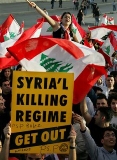
Two things happened this New Year's holiday to reinforce Lebanon's deadlock. The first was the fighting early this week between Hariri partisans and Shiite supporters of Amal and Hizbullah in the mixed Basta neighborhood; the second was the nature of the celebrations welcoming in 2008, a substantial amount of which involved machine-gun fire.
Both events indicated that the next irresponsible step forward by any side in Lebanon's crisis could be the point of no return. The Lebanese are armed, primed, and, while firmly opposed to the idea of war, in a state of mind to sustain one if things were ever to get out of control.
Oddly enough, this balance of terror might be a good thing, as it will oblige everyone to respect the advantages of statis. The parliamentary majority, despite talk of the contrary, will almost certainly not go for a half-plus-one option to elect a new president, because of the likely blowback in the streets; opposition parties must now consider the grave danger of blocking roads again, as some opposition figures have lately implied they would. The system is tied in a Gordian knot that only a regional shift will loosen.
The Syrian regime has blocked everything, but in so doing may have overplayed its hand. Its monochromatic policy in Lebanon - that of re-imposing Syria's writ without compromise - is backfiring. Damascus can destroy but it cannot really build anything. Its ultimate card is a Lebanese civil war, but for the moment Iran appears not to want one. Having spent hundreds of millions of dollars, if not more, on Hizbullah during the past year and a half, it seems reluctant to sanction a debilitating conflict that would swallow up its main Lebanese ally, much as the 1975 Civil War did the Palestinian Liberation Organization. Moreover, sectarian fighting would only mobilize Arab Sunnis against Iran and force Tehran to turn its attentions to a country not a centerpiece of its regional strategy.
Iran and Syria are usually on the same wavelength, but there is a key difference between them. Syria's efforts are largely concentrated on Lebanon, the Assad regime's ticket to regional relevance, while Iran's are not. Without Lebanon - specifically the ability to manipulate violence along the northern Israeli border for leverage - Damascus cannot seriously contemplate resuming peace negotiations with Israel. None of the self-styled mediators between Israel and Syria seem to have grasped this reality. Denied the Lebanese card, Syrian President Bashar Assad has few means of pushing Israel toward a deal he can sell to his own people. That's why his Lebanon policy is not driven by a need to avoid a "hostile" government in Beirut, as some insist; it is driven by the need to dominate Lebanon entirely, without which Syria will remain weak regionally.
The Iranians play on a wider field. Lebanon is important to them, and Tehran will continue to fight hard to avoid a Syrian debacle there. However, the Islamic Republic must also consider its relations with the United States, Europe, and Russia, its ties with the mainly Sunni Arab states (amid improving contacts with Egypt and Saudi Arabia), the balance of power in Iraq, the Iranian economy and its impact on regime survival, and myriad other interests that discourage adventurism in Lebanon. Also, the complex, often hostile, relations between different power centers in Tehran make equilibrium between them a natural default position when shaping foreign policy, checking the behavior of Iranian allies outside.
French President Nicolas Sarkozy got all the attention last weekend when he announced that his government was cutting off contacts with Syria over Lebanon. This detracted from the equally important statement of Egyptian President Hosni Mubarak, who also blamed Syria for the Lebanese impasse. This was the same Mubarak who had repeatedly tried to mediate between the Syrians and Saudis, and who, last November, floated the idea of army commander General Michel Suleiman (then regarded as acceptable to Syria) as a presidential candidate. The fact that Mubarak should have expressed public exasperation with Syria alongside Sarkozy, as the Syrians prepared to torpedo a joint effort by Egypt and Saudi Arabia to hold an Arab League foreign ministers meeting on Lebanon, suggested he is close to the end of his tether with Assad.
It's difficult to have much confidence in the Arab states, but Lebanon's fate has become an existential issue for the Saudis - beyond the question of their support for this or that faction. With Iraq effectively under Shiite control, Iran now spared an American attack, at least momentarily, and Syria and Iran having undermined the inter-Palestinian Mecca Accord, Saudi Arabia is not about to cede more ground in Lebanon.
This week, a story in the Kuwaiti daily As-Siyassah quoted a Lebanese diplomat in Cairo as saying the Saudis believe Syria has sponsored anti-regime Salafists in the kingdom itself. As-Siyassah is close to King Abdullah of Saudi Arabia and no Lebanese diplomat would have made such a charge on the record without getting a Saudi green light to do so. Whatever the truth of the accusation, it is an extremely serious one, underlining that the Saudis are increasingly willing to label the Assad regime a threat to their stability. The logical flip side is that Riyadh might retaliate by playing domestic Syrian sectarian politics.
Pro-regime media and analysts in Syria have lately put out the word that Syria is confident the Arab League summit scheduled for March in Damascus will be successful. That bravado betrays deep anxiety. The summit is supposed to be a crowning moment for the Assad regime, where it can prove that it is a bona fide regional heavyweight. The Syrians hope to use the gathering in one way or another to cash their Lebanese chips in. They also probably hope that a diplomatic triumph will strengthen their hand with Iran, buying Syria more credibility in the partnership and more room to maneuver throughout the region. If the summit is a fiasco, Syria could be shown up as being regionally irrelevant.
No amount of car bombs in Beirut will make the Arab summit a success if the Saudis and Egyptians, like the Americans and French, believe that a dangerous and unreliable Assad merits isolation. A Lebanese civil war, in turn, assuming that Iran would ever agree to push Hizbullah into such a mad venture, could have negative repercussions for Syria itself. Hafez Assad, who always hooked Syrian behavior to a regional consensus; who avoided placing Syria at the forefront of Sunni-Shiite tension for too long; and who always kept an open line to Riyadh, must be rolling in his grave.
Michael Young is opinion editor of THE DAILY STAR.